MIT Mystery Hunt 2026
Background
Mystery Hunt is an annual, weekend-long, puzzle-solving extravaganza held at MIT over MLK Jr. weekend, with thousands of solvers on hundreds of teams that range in size from low triple-digits to solo solvers. Teams solve hundreds of challenging, bespoke puzzles that require wordplay, logic, creativity, lateral thinking, internet sleuthing, spreadsheets, and sometimes specialty skills like knitting, computer science, multiple languages, or obscure fandom knowledge.
This was my sixth mystery hunt, and my second with The Team That is Now Named Later (TTINNL), coming after back-to-back years solving and writing with The Team to Be Named Later (TTBNL). I was fortunate enough to be able to go in person the last two years, but this year was back to solving remotely. I wasn’t able to focus as fully on the hunt as I have while physically present, but my spouse and I were still able to carve out some significant chunks of dedicated time for us to puzzle every day.
Spoilers
Note, there will be spoilers for multiple puzzle solutions below. Tap/click to reveal. I’ve included spoiler tags for ahas, but I’m not going to try to put everything that is a little spoilery in tags.
Friday
Kickoff
It’s a Pokémon Puzzmon hunt! The most Pokémon I’ve played is a little Pokémon Go, and the Super Smash Bros. games (if those even count). But it’s a well-known enough nerd topic that the theme is an easy sell.
DROP * FROM Teams
A SQL puzzle! The actual database portion of this was pretty straightforward. Since we were given the whole database, there wasn’t anything hidden to find in the contents, and the tables joined together in normal ways. The first main puzzle here was figuring out what a few of the inadequately named column titles were intended to represent (perhaps hitting a bit too close to home compared to reviewing others’ code at work). Given the title, I was hoping that this puzzle would involve some SQL injection along the lines of The Day You Begin from 2022, so I was a little disappointed that it seems like the puzzle wouldn’t really have changed much if it had been presented as one big data table without any SQL knowledge whatsoever.
PixelPinpointr
This puzzle is GeoGuessr for videogames, and reminded me of Augmented Raility which I helped write for the 2024 hunt. The solution writeup doesn’t mention Augmented Raility, so the authors may not have been familiar with it. Despite some similarities in the first step (identifying locations within videogames and placing them on their in-world maps), the extraction is completely different. I glanced at this soon after it opened, and the only game I knew was Breath of the Wild. I worked on some other things, and when I came back to the puzzle it was almost done. I was able to be a tiny help in the extraction by fixing one of the extracted locations within Hyrule. The solution writeup mentions that this puzzle was “a lot (a lot)” of work to make, and I believe it. I think the amount of work that must have gone into this puzzle, especially constructing the map, is probably underappreciated. Having done a fair amount of map-making myself for orienteering, I was impressed with their commitment to building all the pieces needed to bring this together.
Squint Your Ears
Amanda and I worked together on this puzzle together, which consisted of about a dozen song clips of famous songs, but with garbled lyrics and some staticy bits. While we were familiar with a bunch of the songs, we’re not good enough at song ID to produce the names just from listening to these snippets. Fortunately, SoundHound was able to knock most of these out. I was impressed with how cleanly the team had isolated and replaced the vocals with the garbled versions (more on that later). We got to work finding the missing words (or maybe partial words it seemed like?) and noticed the ordering mechanism. “Squint” in the title suggested maybe we needed to “look” at the sound clips, so I fired up Audacity to check the waveforms and the spectrograms. We didn’t see anything here, but shortly after a teammate popped in and immediately said >!Is this Simlish?!< Which was both hilarious, and completely correct. It also explained how the garbled versions sounded so good. Armed with this new knowledge, we switched to identifying the >!Simlish!< lyrics to the songs, so I was a little disappointed that despite our team having this correct insight, it ended up being almost counterproductive to our puzzle-solving since >!only the English was needed!< (except in-as-much as it helped us confirm that we only needed partial words).
This Puzzle Has Been Here The Whole Time
I had nothing to do with this puzzle, but someone posted the video you get in our Discord >!with the message from Sam Reich!<, which was a fun surprise.
Setting Boundaries
We helped with some of the grid logic on these. Unfortunately for second we tried, we made an error in understanding the Balance Loop rules, and quickly got stuck.
Mass Confusion
This was perhaps my favorite puzzle, probably in large part because I got to have the major aha moment.
This was part of The Land of No Name round, which had a great mechanic. Initially, all the letters in all the clues had been replaced with identical squiggles, and solving each of the 26 puzzles in the round showed you where all the instances of one more letter were throughout the round (starting with the Zs, Qs, and Js, of course). This meant that even though all the puzzles were “released” at the start, but you couldn’t actually work on most of them until you solved the least language-dependent puzzles first. The only puzzle I worked on in this round was Mass Confusion (or something like Ma** C*nf***on when I started).
When I joined, the team had already identified that the dots on the map corresponded to locations throughout Massachusetts. We had deciphered a number of the clues, and saw that some of the answers kind of lined up with the locations, but we weren’t sure exactly how. Maybe pun alternate versions of the locations? Kind of rhyming? From the flavortext, pronunciation seemed important. When I finally added a column for >!How do the locals pronounce these locations?!<, and we were able to fill it in with non-obvious values for all the locations, we knew we were on the right track. The solution clicked when we figured out that one of the clues was >!”Gardener’s tedious task” with the answer WEEDING, but that to sound like the MA location, it should be pronounced WEDDING, which is… also a word! Now equipped with the idea of pronouncing our answers like MA natives, we found that since Peabody is pronounced “Pib-iddy, that “Corpse on the slopes”, or SKI BODY, would transform into SKIBIDI.!< I’m definitely here for this kind of excellent wordplay nonsense.
It probably helped that I’ve considered writing a puzzle based on this idea for some of the unusual >!place names in Ohio (Russia - “ROO see”, Lima - “LIE muh”, “East Palestine” - “East PAL uh steen”, Versailles - “Ver SALES” etc.)!< Though I hadn’t thought of their great extraction, and this puzzle is much better than whatever equivalent version I would have come up with.
Saturday
On the Fence
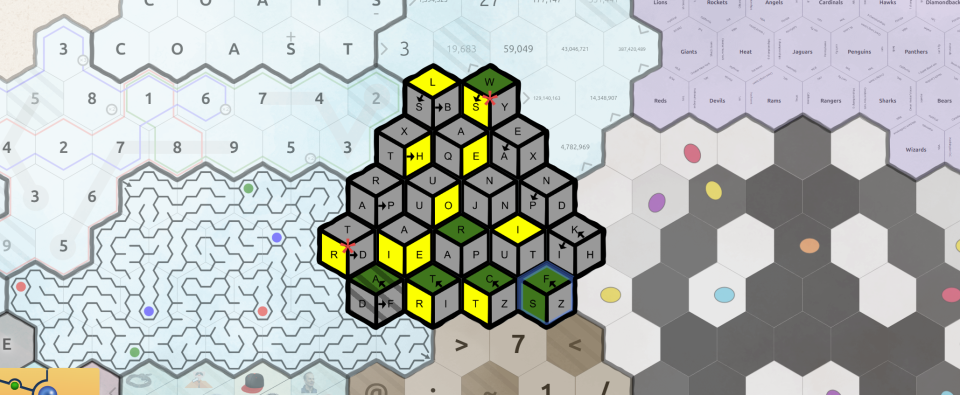
Amanda and I bounced around the Atlas of Mosaics, and settled on working on On the Fence, which was effectively a standard Slitherlink, with the only real twists being that it’s on a hex grid instead of square, and one of the puzzles using inequalities. Being able to make consistent progress on this was a nice change of pace from the start/stop of being variously stuck/stumped on other puzzles.
I was so glad that Cardinality had had the foresight to include the collaboration tools for marking up the Atlas directly. This made it possible not only to solve within the site itself, but also to easily collaborate. So often the running team works hard on making a pretty website, only for participants to spend the weekend staring at sexless spreadsheets. While working on Atlas I had some of the only “tech issues” I experienced during the hunt, which was that when connecting to the Atlas, it sometimes took quite awhile to connect, and after connecting it could take awhile before all of the team’s annotations loaded.
Research Tasks
Some of the Research Tasks were better suited to remote team members vs. on-campus, as we had more supplies to work with. We had some fun setting up a roller coaster in our living room for some of our kids toys for East Campus: Roller Coaster. We also did the Simmons Hall: The Sponge, and Create Your Own Smoot on Sunday.
Sunday
Underwater Hunt
In this round, each puzzle connected back to an old Aquarium Hunt puzzle from a different year, but now in a hex grid and turned up a notch. You had to place hexagons in the grid correctly, then extract an answer. Typically, to place the hexagons and do the extraction, it was helpful to know how the old one worked, but aside from 2025, the other puzzles don’t have solutions online. This meant the individual puzzles had three parts: Aquarium Hunt puzzle, tile placement, and extraction. We mainly worked on tile placement for Triple Your Efforts and Imaginary Architecture, extraction for Triple Your Efforts and TechCASH Windfall. After entering the solution for each individual puzzle, we were rewarded with a word for use in the meta. It was a little unsatisfying that these new words didn’t come from the solutions to the feeders themselves, but I can see the tradeoff that was made for choosing good puzzles and extractions that fit nicely into hexes and used the original Aquarium hunt concepts. I think many of the puzzles would have felt quite strained if they’d had to use the 8-letter words that fit into the meta.
I was a bit disappointed that I didn’t figure out the meta for this one. >!The original meta it was based on made an 8-pointed star formed from two overlapping squares. Since we had 12 answers, I assumed we’d be building a 12-pointed star. While this was right, I glommed onto the idea that the star would be formed by three overlapping squares, and despite the whole puzzle being on a hexagonal grid, missed the possibiliity of two overlapping hexagons instead. We set aside working on the meta to go back and look at more feeders, but I think with a little more careful thought we could have gotten this one a lot earlier, needing fewer feeders.!<
Trends
These were mini-puzzles based on identifying unlabeled trendlines, given a graph title, axis labels, and datapoints. After identifying the label, solvers apply some transformations listed below the puzzle to convert it to the answer. For Trends: Names, I thought about pulling SSA name data (which I’ve done before for various projects), but that seemed like significant overkill for this little puzzle. This seemed like a good candidate for an LLM. I asked it about a 2014 name spike, giving the approximate values before and after the peak, and it was able to identify the correct name. Instead of looking up the graph for the name to check, I tried to see if the answer made sense after applying the transformations. When it did, and the listed transformations on the other side made it clear that the answer would start with a 5-letter word containing an “I”, Nutrimatic finished the job without having identified the other name. This was my only solo solve of the hunt.
AI Puzzle-solving
Post-hunt, out of curiosity I gave the entirety of Trends : Names to Gemini 3 Pro as a single image, and it very quickly and correctly one-shot the solution.
I was right that LLMs would still be allowed for solving puzzles this year, though generative AI was banned for Research Tasks (the Scavenger Hunt), which I believe was a first. I do wonder if the permissive policy will change in the coming years. As I understand it, puzzle-solving tech has been a rising tide that has raised both the skills of solvers, and the expectations solvers are held to by the writing team. Some old puzzles are rendered much easier by Wikipedia, TinEye, SoundHound, Nutrimatic, Quipqiup, and so forth. A member of Hunches in Bunches described that AI one-shot at least 9 of the text-only puzzles for them. There’s universal agreement that AI was much more useful and capable in assisting puzzle solving this year than last year.
Are we headed for an MITMH future where the first step of solving every puzzle is to ask an AI if it can solve it? Will Providence and future writing teams need to use AI-solvability as a metric during testing phase? Will LLMs or any other AI tools be banned in the future? I’d like to think that as long as humans can still do meaninful labor in the marketplace, writing teams will be able to write puzzles that humans are better at than AI. The spiky nature of AI intelligence means we have AI that can solve 97% of Connections puzzles on hard mode, but still can’t read sheet music, and can’t always reliably count the letters in a word.
Closing Thoughts
Thanks Cardinality for putting on a great hunt! I know I didn’t get to see or appreciate even a tenth of the magic (including all the in-person stuff), but from what I experienced, it seemed like it was very well-sized, was pretty, had a fun theme, was technically polished, and held lots of surprises and whacky rounds.
I look forward to seeing what Providence cooks up for 2027!