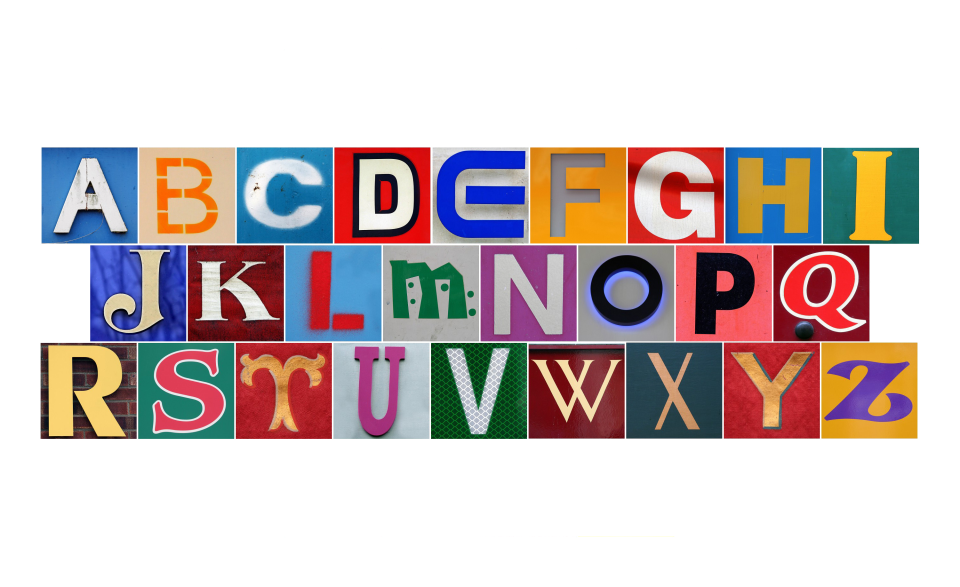
For those not familiar, the Alphabet Game is a classic road trip game, played by children before the invention of the iPad. In it, participants try to find consecutive letters of the alphabet, working all the way from A to Z as quickly as possible. Sounds simple, but there is lot’s of room for house rules and variations.
I’ve been thinking about it more recently for two reasons: first, on a recent road trip, I discovered that my family played an “easy” variant compared to my sister-in-law’s family, and second, I’ve recently been commuting by bike through downtown Columbus more frequently, so I’ve taken to inventing more variants.
So what’s the “easy” mode and “hard” mode? Well my family allowed you to find a letter anywhere in the word, while my sister-in-law’s family required that it was at the beginning of a word. I think both of these variants are fairly common. Here are some other rules that groups might play by:
- The game is cooperative: everyone works together to find the next letter
- It’s competetive. Everyone for themselves, and once a letter is used, no one else can claim the same letter
- You can’t make the letters yourself (e.g. writing them down)
- The letters have to be outside of the vehicle
- License plates are allowed (or not)
- Words starting “Ex…” count for “X” (or not)
- Things shaped like an “X” count for “X”, even if it’s not a letter, per se, (e.g. a railroad crossing sign)
And here are some of the variants I’ve come up with:
Letters “by themselves”
The Letter is Pronounced
Normally the letters you find are mixed into words. While “STOP” certainly has a “T” in it, doesn’t the “T” in “T.J. Maxx” embody “T”-ness more fully? In this variant, you must find letters that when read by a person, would cause them to pronounce that letter.
This is a nice idea, but in most cases, it essentially means you’ve changed it to a standard version of the alphabet game where you can only use license plates, unless you specifically make that illegal.
Standing Alone
As a patch to the previous idea, that hopefully fixes the license plate issue while still finding letters that feel special, let’s consider letters to count only if they are standing alone. That is, either they are by themselves, or they are set apart from other letters by spaces, periods, hyphens, numbers, etc. So you might find an “A” in “U.S.A.”, a “B” for apartment “123B”, a “P” for parking, or an “X” in “4x4”.
You might notice that while this patch might make the game yield letters that are more “special”, it also makes it way more difficult than even the “hard” mode from above. Since we’ve dialed up the difficulty this way, we need some other changes to counterbalance it. The first change is that you can find the letters in any order. This now means that unless you’re writing it down, this is not just a game of visual perception, but also one of memory. The second is that even with this change, it may still be too hard to find them all, so instead of finding them all as fast as you can, the goal may instead be to find as many distinct letters as you can within a time limit.
Alphabet Book
A slight variant on the above is to require that the letter stands for something specific, as if you were writing an alphabet book. We also relax the “standing alone” rules, So using the examples from the previous game, we would allow “A is for America”, and “P is for Parking”, but we’d need to find different options for “B” and “X”. And you could still count A if it were written “USA” instead of “U.S.A.”. If you find a street or building named after someone that includes a middle initial, you can only count it if you know that person’s middle name.
Abbreviation Starters
Same as above, but you don’t have to know what the letters stand for
Abbreviations
Like the above, but if you see “Org.” you could use any of “O”, “R”, or “G”.
Other games
Objects
Find nouns that start with the letters. No written words needed. You can get creative here, so be on the lookout for “Xenophiles”. If you allow counting yourself you can make this into a sort of alphabet poem. Here’s a set that works for me:
- Adult
- Buckeye
- Coder
- Dad
- Elk (high school mascot)
- Flexitarian
- Grandson
- Husband
- Introvert
- Jim
- Knight (college mascot)
- Leo
- Math-enthusiast
- Nerd
- Orienteerer
- Percussionist
- QA Tester
- Rationalist
- Son
- Thinker
- Uncle
- Valentine
- Wit
- Xenophile
- Youngest
- Zendo-player
Ending letters
Perhaps surprisingly, this is a lot more challenging than starting letters. There are a lot of common endings in English, (such as “s”, “ed”, “ing”, and “y”), and a lot of uncommon ones (such as “J” and “Q”), so these harder letters you tend to get through the the usual hacks like license plates. It’s also harder because, at least for me, words are more categorized in my head by their first letters than by their last, so I have to actually think/parse words to notice what they end with, instead of being able to tell at a glance without really reading the words if there’s a matching starting letter.
Central letters
It has to be a middle letter of the word. Hard mode is to only allow the exact center, and therefore only allow odd-length words, so a sign for “BAXTER AVE” would give you only V. Medium difficulty would be to allow even length words, so the same sign would give you X, T, or V. The easiest version is any letter that’s not first or last, so A, X, T, E, or V in this case.
Echolocation/LIDAR
Letters seem more special if they are physically sculpted/molded into the real world as opposed to just printed on a sign. The golden arches embody the spirit of M moreso than the ones in AM or PM on a parking sign. So how can we encode that into the rules? Suppose a bat were playing. Which letters could they make out just with echolocation (ok, probably none, but we could say LIDAR instead). Unfortunately, if you’re in a state with stamped license plates, we’re back to plates being the dominant strategy.
Kleptomaniac version
On a license plate, the letter has physical form in the real world, but it’s part of the whole plate, rather than one thing on its own. In the kleptomanica version, you can only count the letters that one could theoretically “steal” individually. This is another hard variant where you’re probably going for a high score, and maybe playing out of order, rather than trying to find everything.
Other variants/extensions
This game is easily modifiable into even more variants, here’s a few more:
- Capital letters only
- Lowercase only (much harder than capitals in my experience)
- Serif fonts only
- Sans serif only
- Extend to numbers starting with certain digits
- Look for specific punctuation, for example the ones associated with number keys on a keyboard
Image license and attribution: CC BY-NC-SA 2.0, Image was modified. Original image from https://www.flickr.com/photos/lwr/168967620